Embodiment and Perception: How can interactive art/installation reframe how we sense and inhabit our own bodies?
2025
My research practice throughout the year will explore the way interactive installation and immersive technologies can transform the way we sense and inhabit our bodies. I am interested in exploring the way in which embodiment, transformation, and sensory perception intersect, and how personal experience and the way in which we experience ourselves and our environment can be translated and expressed through art. This arises from my childhood experiences with heightened sensory perception as a neurodivergent person, who often wondered whether others dealt with the same painful overstimulation, but also sometimes deep euphoria, from certain lights, sounds or textures. These are themes I will be learning to express within my practice using various technologies.
My current practice explores the use of sound, film, performance and sculpture to create spaces of reflection. My exploration into sound art and multimedia installation began with Caleb Kelly’s Sound: Documents of Contemporary Art (2011), in which he observes that “cities are noisier than they ever were in the past” (Kelly, 2011, p. 13). This resonated strongly with me at the time, after moving from a quiet rural area to the much louder cityscape of Liverpool. I found that this sudden change exasperated and intensified my awareness of sensory overload and the noises within my surrounding environment. Kelly’s discussion of sound slowly becoming a pervasive and overcoming element of contemporary life made me reflect on the idea of sound within nature, the contrast created if excessive noise was played within a grove of trees, and how sensory experience and sound can be both oppressive and expressive, depending on the context or environment. This line of questioning first inspired me to use sound and sensory media as tools for exploring and communicating embodied experiences through art.
(Barr, 2025).
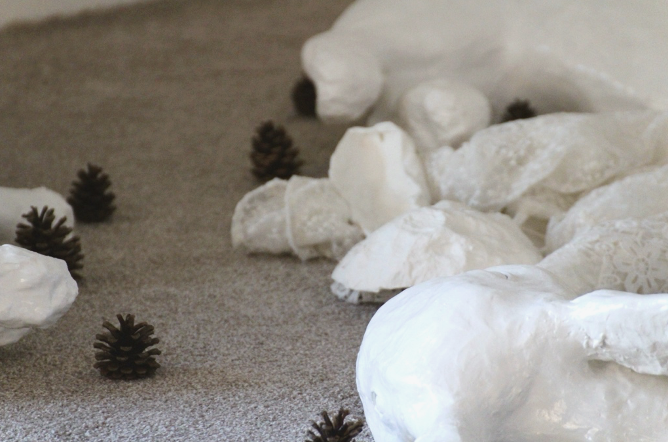
In my previous work After Orion (2025), I explored embodiment and transformation through a multimedia installation that combined film, artifacts of a performance, and multisensory elements designed to create a comforting and accessible experience for those who experience a similar sensory overwhelm to myself, whilst tackling difficult themes such as grief. This installation has been my most successfully realized piece so far, however, it some-what lacked in its ability to immerse the viewer due to limitations in space and resources at the time. This is something I would like to overcome going forward, and why more recently, my interest has expanded towards virtual reality (VR) and its ability to trick the mind into believing new perceptual realities. I am currently developing an interactive installation involving a 360° camera and a VR headset that will allow participants to encounter themselves in a three-dimensional virtual space and confront who they are beyond reflective surfaces and photography. When discussing this concept with peers, I’ve found the common reaction to be unease or even disgust at the thought of “being in a room with yourself.” This response prompts questions around societal self-image and discomfort within one’s body. Through this project, I intend to explore how immersive technologies can challenge and reshape self-identity and perception.
Aim 1: To develop my understanding of the connection between autism and sensory perception, and to explore how immersive installation can translate these experiences.
As someone with lived experience of neurodiversity, I aim to understand how sensory differences can shape personal perception and how this understanding can make my art more inclusive. Sensory perception in those with autism is often labeled as either hypersensitivity or hyposensitivity to stimuli, resulting in unique ways of experiencing sound, light, and texture. My aim is to translate these different sensory experiences into installations that communicate both the euphoria and intensity of such moments.
(Cardiff, 2012).
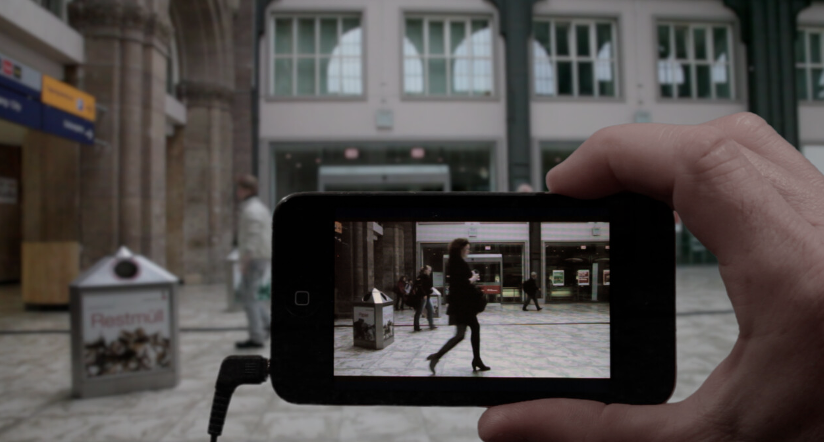
To begin developing these themes, I will research artist whose works engage with the viewer on a sensory basis, such as Janet Cardiff’s immersive sound walks that aim to immersive the listener in their physical surroundings in an uncanny and specific way.
I also plan to continue documenting sensory moments from my daily life that invoke emotional or physical responses, collected in the forms of field recordings, videos, and cuttings/rubbings. These will act as research material and maybe aesthetic elements within future works.
When creating work of this nature, ethics are something which need to be carefully. While I wish to tap into multiple sensory elements and evoke strong sensory experiences, I must also ensure accessibility for those who experience sensory overwhelm. Whilst making my previous works, I have emphasized the importance of comfort and emotional safety of my audience and will further this emphasis by consulting neurodiverse participants through either focus groups or surveys. This participatory element will develop my research by prioritizing multiple perspectives on sensory experience and embodiment.
Aim 2: To explore how interactive installations can create perceptual or emotional transformation through physical and digital engagement.
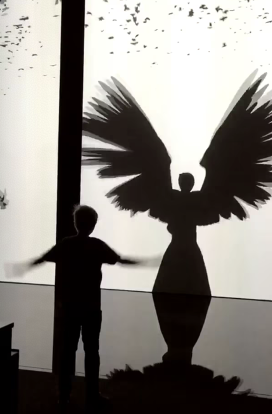
My second aim is to explore the transformative possibilities of interactive installation. Interactive art prompts the viewer to engage physically as well as emotionally with the work, making the space into a more immersive environment. In works such as Chris Milk’s The Treachery of Sanctuary (2012), viewers witness their shadows disperse and transform into birds. I find myself drawn to the simplicity of the piece, whilst inciting a sense of amazement and existentialism. This use of projection and interactivity to visualise transformation prompts me to question how the mind reacts to an alteration of the relationship that it has with its idea of self. This is something I would like to explore within my practice using projection, aiming for simplicity to successfully create a calming environment.
(Milk, 2012).
I have begun experimenting with VR, 360° video, and projection mapping using software’s such as MadMapper and Isadora. My aim is to figure out how I could use these technologies within my practice to encourage sensory and bodily interaction with my art. When previously testing a 360° camera and watching back the footage through a VR headset, I accidentally became face-to-face with myself, created a disorienting moment of self-awareness and reflection. This interaction between you and yourself, between the virtual and the embodied, is what I will be exploring within my practice. I will explore this through the interactive 360° video and VR piece mentioned previously.
(Lozano-Hemmer, 2010).
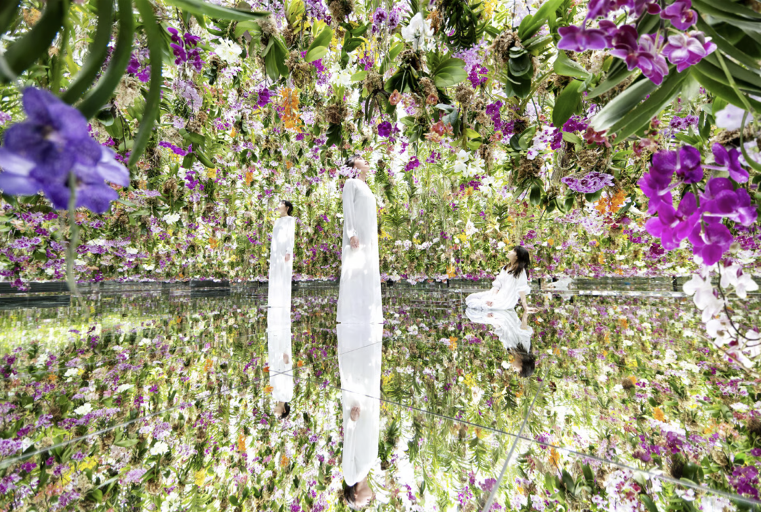
(TeamLab, 2025).
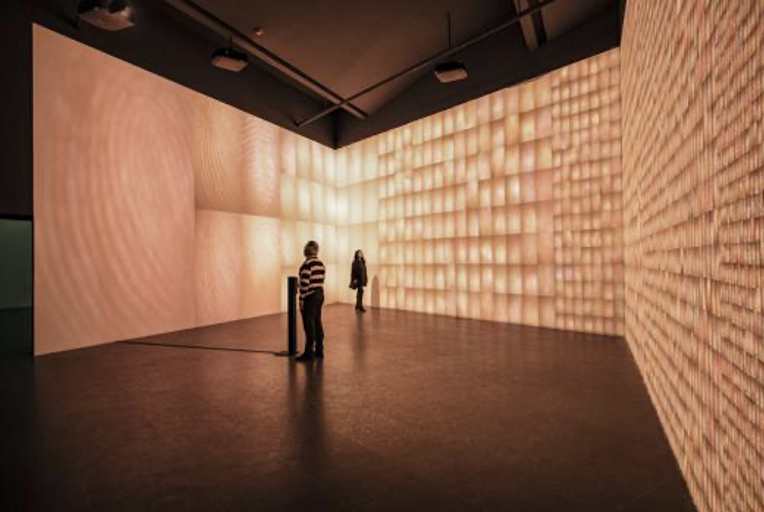
Alongside further experimentation, I will be looking into more examples of work that encourages the viewer to interact with representations of themselves, or their environments. Some examples I have found, but not yet fully researched, are Rafael Lozano-hemmer’s Pulse Index (2010), an interactive installation that takes a recording of the participant’s fingerprint then detects and displays their heartrates, and TeamLab, who create large-scale digital spaces that look like stepping into pockets of another reality. These examples will help guide and inspire me when creating transformative, sensory based interactive works.
Aim 3: To ground my practice in relevant psychological and theoretical understanding on embodiment, perception, and transformation.
In order to gain a better understanding of the subjects that I am interested in; I will explore various relevant psychological theories that examine how the human mind and body perceive and construct reality. Starting with Merleau-Ponty’s Phenomenology of Perception (1945), who’s book explores existentialism and phenomenology in post-war Europe, and studies historical cases of psychology and neurology, such as synesthesia and hallucination. This research appears to align with topics that I am exploring and attempting to understand. Another avenue to explore is, Don Ihde’s Listening and voice: Phenomenologies of sound (2007), who explains the importance of sound and listening in our lives, which will hopefully inform my knowledge on how technology and the body can affect sensory perception.
I will also research into the psychological effects of VR on the mind and body, Environmental psychology and health; Research in VR and real settings (2024) by Chiara Burattini, et al, explores recent studies that investigated VR and its effects on the mind and body through environmental stimuli. Understanding these studies will help me to use elements of VR within my practice safely and more considered.
Next Steps.
To accompany my practice-based experimentation, I will be continuing to engage with relevant literature on neurodiversity, sensory art, embodiment, interactivity, and installation. I also plan to attend local exhibitions and events that focus on immersive media and accessibility in art, helping me to further my understanding and enrich my inspiration in a more practical sense.
Moving forward with these ideas, I will begin further experimentation with 360° video and VR towards the interactive installation concept I mentioned earlier. For this piece, participants will be guided into a private space with a 360° camera and asked to record a short message for their future selves, with prompts if needed. The recording will then be transferred in real time to a VR headset for the participant to wear and watch back, transporting them into a virtual space where they are confronted, face-to-face, with themselves.
To start experimentation towards this piece, I will put together a small-scale replica of the concept to test how participants respond to seeing themselves within virtual space. I will then record these test versions using qualitative methods such as participant feedback forms or surveys and analysing emotional and sensory responses. These methods of analysis will help me to understand how to better create the final, public installation.
Leading up to January, I intend to produce a series of experimental works using projection mapping and spatial sound. These experiments and studies will eventually contribute towards my MA final project, where I hope to create a finalized immersive installation that explores the themes of embodiment and perception and is accessible to those who may usually struggle in a gallery setting. By reaching an intersection between of theory, technology, and lived experience, I aim to create works and spaces that invite the viewer, or participant, to reflect and transform and garner a deeper understanding of the human form.
Bibliography
Barr, D. (2025) After Orion [image], unpublished work
Kelly, C. (2011) Sound: Documents of Contemporary Art. London: Whitechapel Gallery / MIT Press.
Cardiff, J. (2012) Alter Bahnhof Video Walk [online image] Available at: https://cardiffmiller.com/walks/alter-bahnhof-video-walk/ [Accessed: 6th November 2025]
Milk, C. (2012) The Treachery of Sanctuary [online image] Available at: http://milk.co/treachery [Accessed: 6thNovember 2025]
Lozano-Hemmer, A. (2010) Pulse Index [online image] Available at: https://www.lozano-hemmer.com/pulse_index.php [Accessed: 6th November 2025]
TeamLab (2025) Planets [online image] Available at: https://www.teamlab.art/e/planets/ [Accessed: 6thNovember 2025]
Merleau-Ponty, M. (1945) Phenomenology of Perception. London: Routledge & Kegan Paul.
Ihde, D. (2007) Listening and Voice: Phenomenologies of Sound. 2nd ed. Albany: State University of New York Press.
Burattini, C., D’Aurizio, G., Broszio, K. (2024) Environmental psychology and health: Research in VR and real settings [online], v.15 (1), p.102478. Available at: https://www.sciencedirect.com/science/article/pii/S0272494424002512 [Accessed: 6th November 2025]
