Pet and Pest
Pet and Pest – The rabbit as a metaphor for European Colonialism and how artists used the story of rabbit colonization to make visible the impact of global politics and power relations in colonized land.
2025
In this essay, I will be looking at how the representation of the rabbit is used within art, specifically Australian art, focusing on the artworks ‘Terra Australis – New World Order’ (2011) by Jenny Pollak, ‘The Rabbits’ (1998) by John Marsden and Shaun Tan, and ‘Footprints on the Rabbit Proof Fence’ (1987) by Judith (Anya) Samson. I believe these works will be significant to developing my own personal practice because each example uses the rabbit’s colonial impact on Australia differently.
My Practice
In my practice, I have been using imagery of the rabbit express my personal emotions and experiences, drawing inspiration from the world around me.
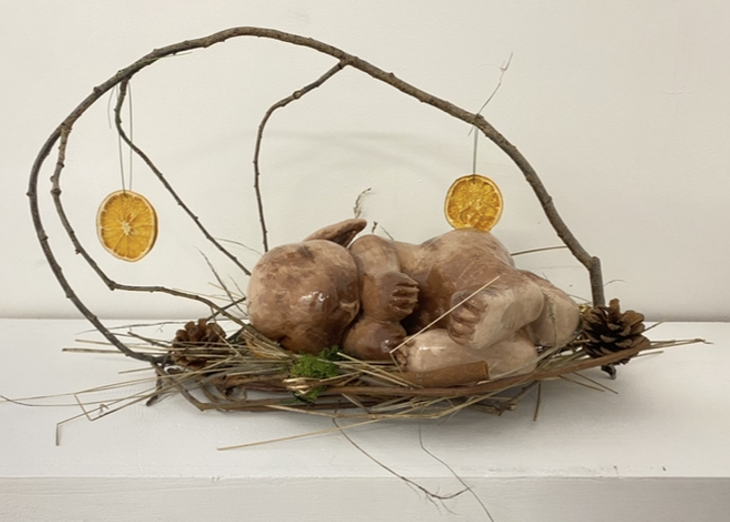
‘Before Orion’ (2024)
Lately, I have been drawn to Sculpture as my medium. Leading me to create pieces such as ‘Before Orion’ (2024), a curled-up, possibly hibernating (maybe dead) rabbit that is loosely based off my first pet bunny and the mythologies behind the hare constellation. This concept is a ‘nice’ start to my current practice but is in no way representative of the deep, critical, contextual themes that I wish to explore within my work. My initial research into artists working with rabbit imagery led me to Jenny Pollak’s sculpture ‘New World Order – Terra Australis’ (2011), which maintains balance between personal and contextual themes that the rabbits portray, a balance I intend to focus on achieving in my work going forward. This has inspired me to attempt to prioritize research in my practice rather than my emotions being at the forefront, hopefully leading me to contextualize my rabbits and retrospectively place them into a critical context.
The Good, The Bad, and The Sculpture
For Jenny Pollak (b.1957), an Australian artist and poet that works predominantly in sculpture, photography and video installation, the rabbit holds a sense of endearment, growing up with them as family pets. However, with her parents working in biology and zoology, Pollak developed a deep love for nature, gaining a great understanding of the environment she lived. This meant she could understand the vast and immense effect that the introduction of invasive species has on the native land, particularly the introduction of the rabbit to Australia by British colonialists. This conflicted upbringing led Pollak to create a sculpture comprised of six matt white ceramic forms, modelled on the European wild rabbit, that she named ‘New World Order – Terra Australis’ (2011).
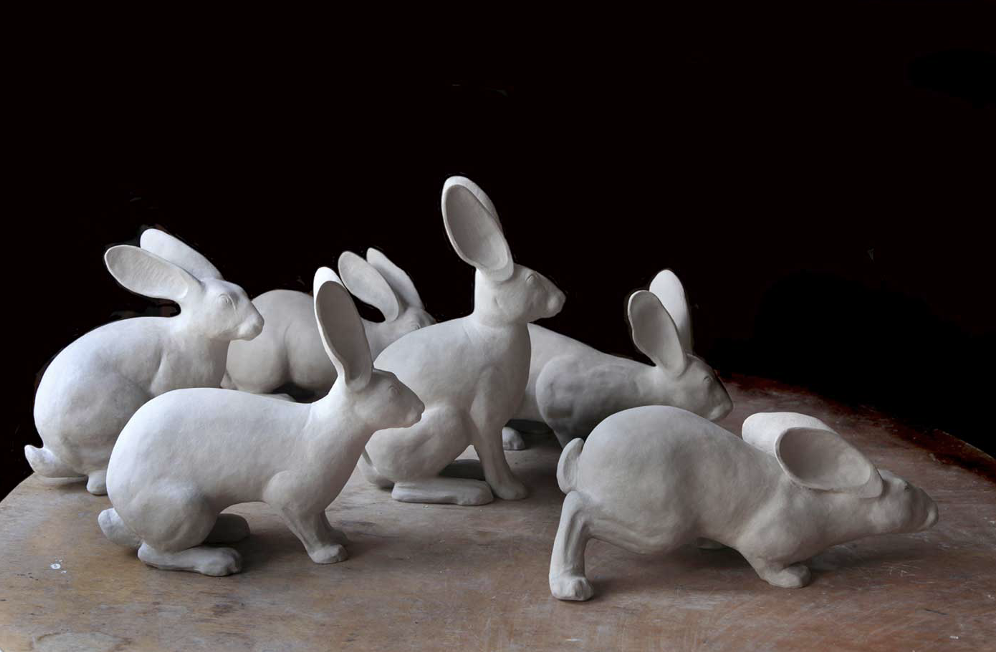
‘New World Order – Terra Australis’ (2011)
‘New World Order – Terra Australis’ (2011) explores the relationship between humans and rabbits. It examines the tensions and contradictions in the way people of Australia view the rabbit. From first view, the title emphasizes the rabbit’s capacity to reproduce on mass taking over the land. Pollak uses Latin terminology, ‘Terra Australis’ translating to ‘land of the south’, to play on the European scientific traditions of classification. Although, without knowing the translation, the title is reminiscent of the word ‘Terror’, often used to describe the rabbit within Australia. The title then comes across to non-Latin speakers as the ‘Terrors of Australia’. The title also invites the viewer to contemplate the ‘invading force’ of the rabbit population in Australia and the way it’s destroying the native habitats, wiping out the established ways of living, and forming a ‘New World Order’ across the land. In the book ‘7 New worlds: violent intersections in graphic novels’ (2021) by Jessica Gross, a novelist and essayist from New York, Gross argues the so-called ‘New world’ is the world that was there before the invasion of colonialist forces. However, in Pollak’s title, the ‘New world’ is what has become of the land after the invasion. This is because Pollak is speaking from the point of view of the original beings, and Gross, the invaders.
The form of the rabbits, arguably, holds a closer resemblance to the Belgian Hare, rather than the European wild rabbit. This could possibly be subconsciously informed by close contact with domesticated rabbits, inciting the viewers feelings of care and adoration we have for our pets. This could also be due to the purposeful emphasis Pollak has put on certain characteristics. When viewing the sculpture, it’s hard not to immediately focus in on the ears. They are larger and more prominent than common depictions of the rabbit, making the rabbits visually striking, appearing more powerful than an ordinary rabbit. The visibly muscular shoulders and larger back feet add to the unnerving strength these rabbits seem to possess. Pollak’s emphasis on the rabbit’s already unique features suggests this is a menacing creature, reinforced by the collective stances of the rabbit pieces brought together, facing forwards to instill an ominous feeling of an impending attack.
The rabbit is an underestimated animal, but together, they are a force to be reckoned with. ‘New World Order – Terra Australis’ (2011) was displayed alongside a section of the original Rabbit Proof Fence, intertwining the rabbit art and its history. Overall, this shows how rabbits have influenced Australian culture and art in both negative and positive lights, with Pollak’s struggle to contend both her love and hate for the animal she has sculpted. Finding and researching this piece took me on a deeper investigation into the specific narratives around the rabbit in literature but also the social and political impacts of the rabbit’s introduction to Australia.
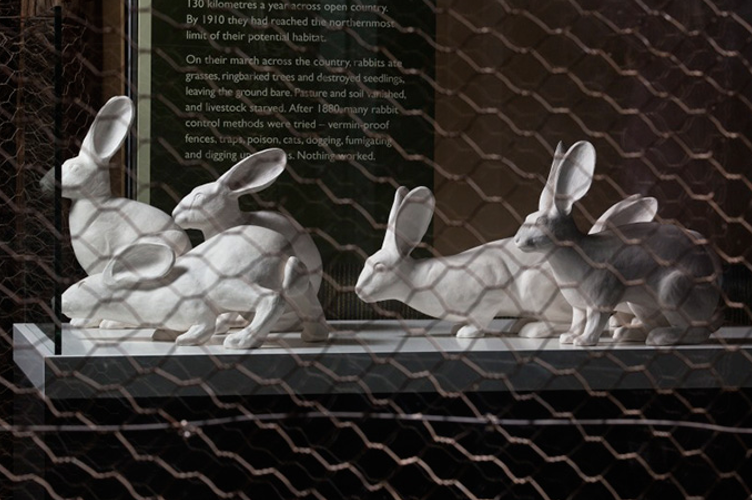
‘New World Order – Terra Australis’ (2011) In the National Museum of Australia
The Rabbit
Historian and curator Victoria Dickenson wrote the book ‘Rabbit’ (2013), an extensive exploration into the natural and cultural history of the rabbit, and an important starting point for my research:
“The rabbit is a paradoxical beast. It is an animal at once both pet and supper, pest and product, invasive yet endangered, prolific yet declining. Even its natural history displays a strange contradiction, a story of an animal both wild and feral, with a worldwide distribution made possible by the actions of its greatest predator.” (Dickenson, 2013, p.1)
Throughout history, the rabbit has shaped the lives of its human friends and foes. They reside in a large part of the human imagination. “Their ubiquity, their almost comic (in human terms) appearance, combined with their strange and troubling presence” (Dickenson, 2013, p.94) has had mass significance within human culture worldwide. Imagery and symbolism of the creature is found to be present in poetry, stories, paintings, signs and tokens, carvings, and so forth. The rabbit, although silent, speaks volumes in its actions and expressions. Whether it’s a pet, a pest or a symbol of mischief, curiosity, lust, fertility, innocence, or luck, rabbits have deeply entrenched themselves into various cultures around the world, and therefore, has had an everlasting effect on art (Dickenson, 2013). Given the vast effect that the rabbit has had across the world, we will be focusing on the artistic representations of the European rabbit’s (Oryctolagus cuniculus) within Australia. What did its introduction by British Colonialism mean for its society and its natural environment? And what effect did that have on Australian art and culture?
Australia and the Rabbit
The European wild rabbit first appeared in Australia in October 1859, released into the countryside by an English man called Thomas Austin. He was sent 24 rabbits by his nephew, along with various other game animals, and those 24 rabbits rapidly grew to an exponential 600 million within the century. Documented by various forms of media is the complete invasion of this small, fluffy tailed creature “the rabbits have driven out of the great districts both the sheep and their owners” (The Lancet, 1909, p.864) and the people of Australia’s unsuccessful but incredible attempts to stop them. A real life, age-old tale of the cottontail and the farmer’s garden.
This began with the invention of the ‘Bunny Boards’, basic stone walls or wooden post fencing that proved to be useless against the rabbit menace. The Australian government and landowners then implemented more that 48,500km of wire fencing, with patrols on camel-back (and later cars) proving to be a success for some time (Dickenson, 2013). The fence fell under some artistic scrutiny, like in the comic ‘Stevenson’s Wire fence’ (1884) published in response to the fence, because just like in the stories of Peter Rabbit, ‘The Tale of Peter Rabbit’ (1902) by Beatrix Potter, and Brer Rabbit, ‘Uncle Remus, His Songs and His Sayings: The Folk-Lore of the Old Plantation’ (1881) by Joel Chandler Harris, the rabbit always finds a way.
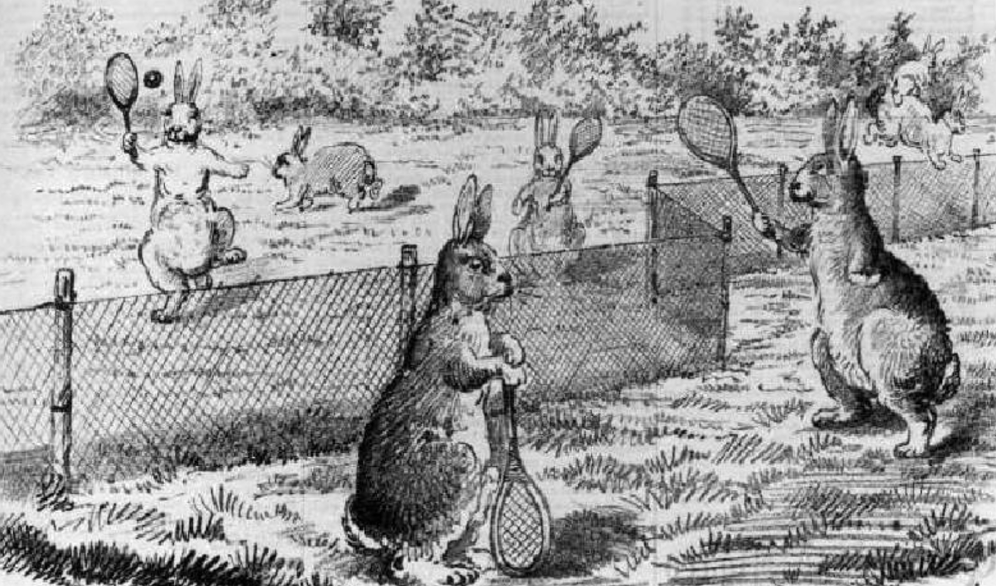
‘Stevenson’s Wire fence’ (1884)
After the second world war, Australia’s soldiers returned to focus their efforts on their longer lasting invaders referred to as “Public enemy number one” (Menace of the Rabbit, 1948: 00:06) in ‘Menace of the Rabbit’ (1948), a newsreel and call for arms highlighting the degradation of Australian habitats. Within this black and white film, rabbits are seen hopping around sandy wastelands, dust storms and chewed-up trees. The swarms of rabbits appear like locusts over the dry, baren fields (00:01-00:45). ‘Menace of the Rabbit’ (1948) also features shots of the wire fence, panning from the barren lands on one side of the fence to the tall, rich and healthy grass on the other, the narrator claims “wire fences will stop the rabbit invasion” (Menace of the Rabbit, 1948: 01:01) only to show later in the film (01:25-01:30), destruction of the wire and wear to the grass underneath, marking where hordes of rabbits have broken through.
Colonialist Bunnies
The European rabbit was brought to Australia by British colonialism and the effect of the rabbits have a similarity to that of the colonisers. ‘The Rabbits’ (1998) is an Australian graphic novel written by John Marsden (b. 1950) and illustrated beautifully by Shaun Tan (b. 1974). It is a story about experiencing colonisation, told through the eyes of those colonised. The narrative depicts the colonisers as ‘rabbits’ and describes their invasion in a minimal way, leaving Tan’s Imagery to do the talking. The story follows the arrival the rabbits, starting off with innocence, friendliness and curiosity, but has an ominous sense that something is wrong as the rabbits begin ignoring the marsupial-like creatures to build their ‘New world’ (Tan, 1998). Later, the story twists into darkness and horror as we realise why the rabbits are there.
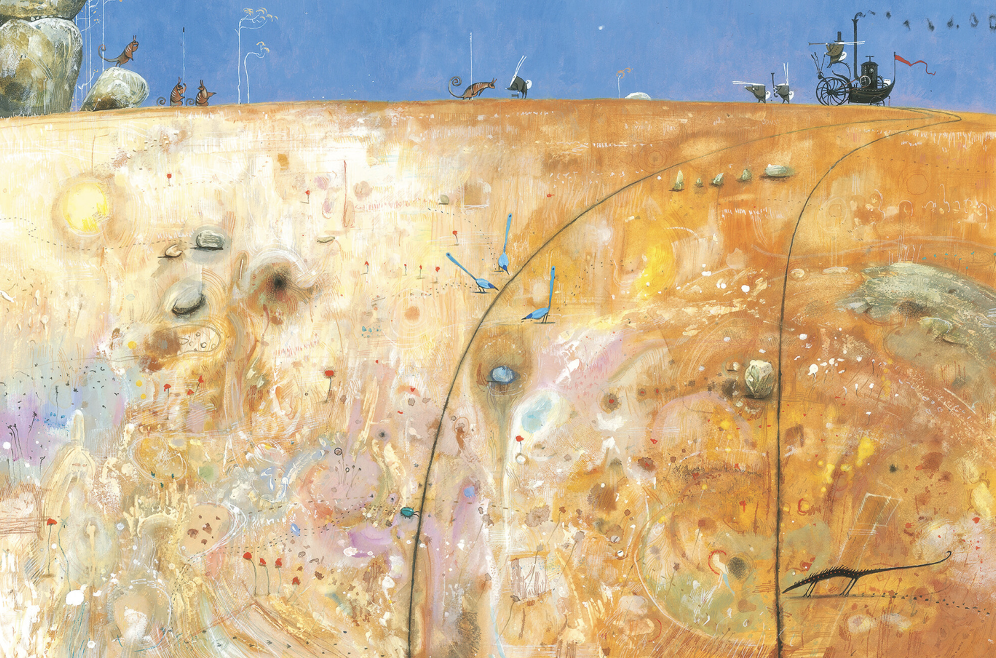
‘The Meeting’ (1997)
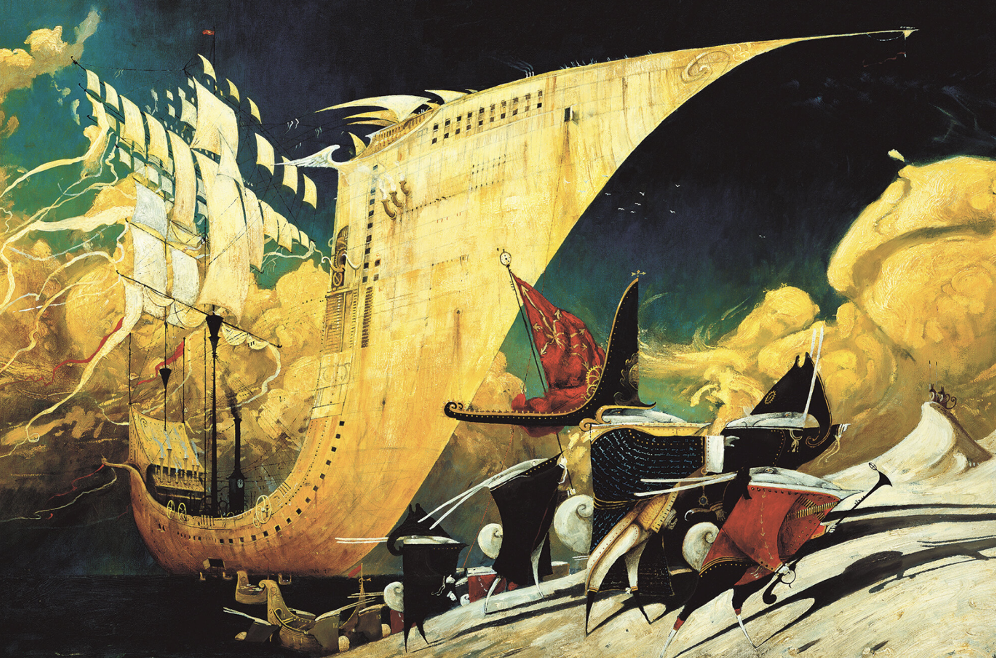
‘They came by water’ (1997)
Tan’s artworks begin with beautiful depictions of Australia’s native landscapes. In ‘Meeting’ (1997) on opening 2, the bright, summer colour pallet and swirly brush strokes intertwine to emphasise the beauty of the natural fauna before the invasion. The land is shown to house many tiny creatures, birds, and insects, taking up most of the page, making the rabbits and marsupials appear insignificant on top. This emphasises the land’s monumental beauty before the rabbits’ assault takes hold. As well as being our last glimpse of the expansive natural world that those native have left blossoming without interference, we can see the subtle, dark markings of the rabbits’ vehicle, foreshadowing the negative impact the rabbits will have. This has a visual contrast to ‘They came by water’ (1997) on opening 4, quickly moving from the stunning natural world to harsh industrialisation, where we see the rabbits’ enormous and advanced ship compared to the tiny marsupials onlooking the arrival in the right.
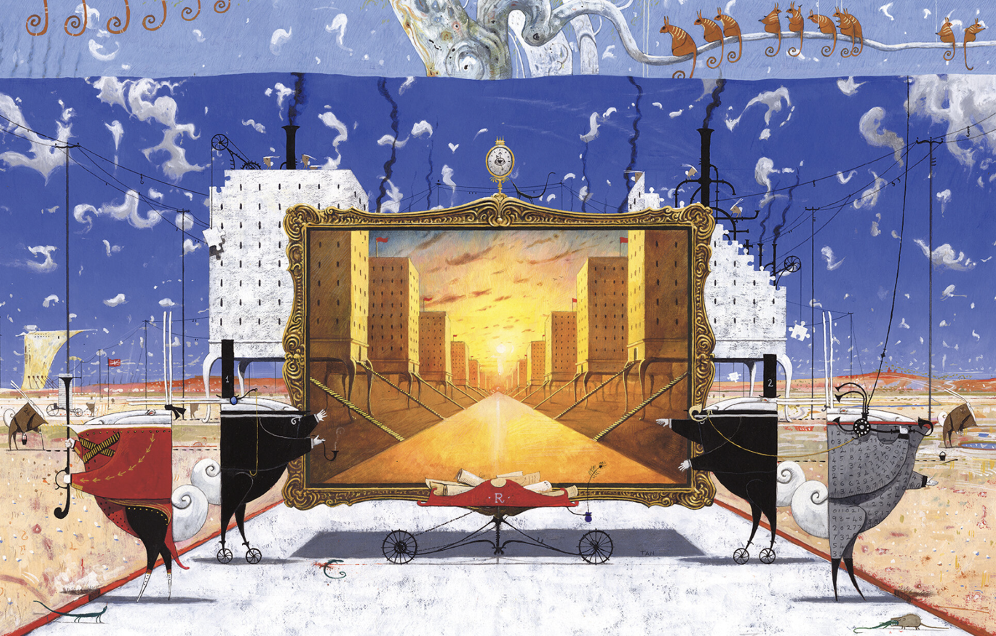
‘Rabbit Houses’ (1997)
We begin to see how fast the population of rabbits is growing, as rabbits are known to do, by ‘Rabbit Houses’ (1997) on opening 5. In a tiny sliver at the top, rest the marsupials in their trees, and in an opposite format to ‘Meeting’ (1997), the rabbits dominate the rest of the page. Marsden’s’ words, “They made their own houses” (Marsden, opening 5), show disregard to those who lived there before, shunned and uninvited. The buildings forming as puzzles, already beginning to spew black smoke into the darkening blue skies, envisaging the impending destructive effects on Australia’s natural landscapes by the colonisers. Everything is mechanical and symmetrical, symbolising the unnatural positioning of industrialisation. During an interview with Tan by Nick Stathopoulos, an Australian artist and Illustrator, Tan explains why the rabbits’ houses stand on what looks like furniture legs. The reason being that the rabbits lack a “Material or conceptual relationship to their new environment” (shauntan.net, 1997, para.19), they don’t care for the world they have landed on, only for what ‘New World’ they are erecting, reinforcing the comparative use of rabbits and British colonialists. Although Gross argues that when coming from the colonisers, the appointed ‘New World’ wasn’t new. Through violence, upheaval and invasion, they merely copied their ‘old’ world, “The so-called new world had been there all along; what was truly new was Europeans’ contact with it” (Gross, p. 116).
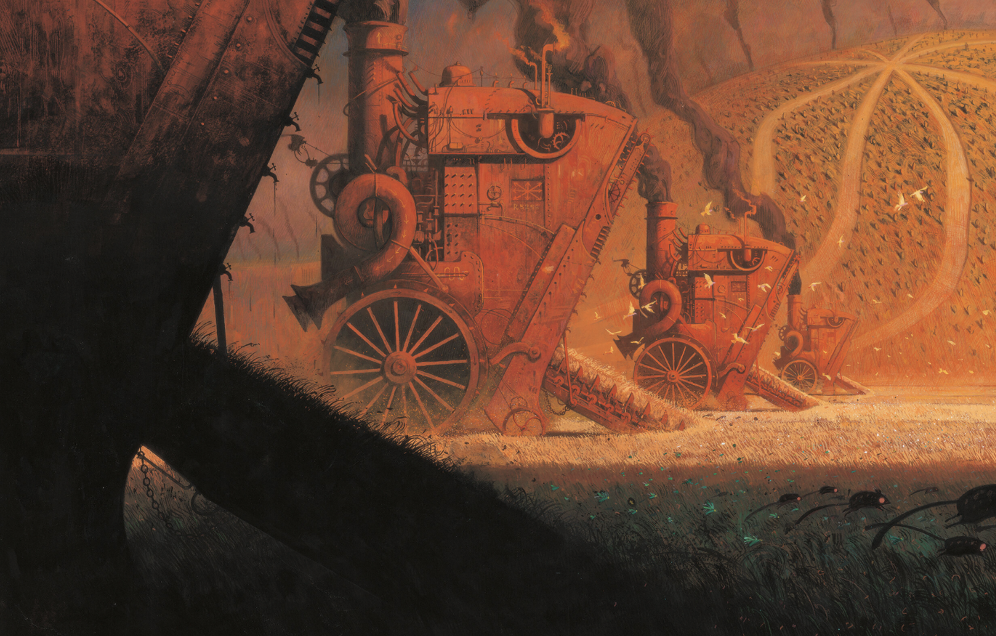
‘They ate our grass’ (1997)
On opening 7, Marsden writes “The rabbits spread across the country. No mountain could stop them; no desert, no river.” (Marsden, opening 7). This is also true for the actual rabbits in Australia, brought by those that Marsden is referring to. The rabbits spread across the country, an unstoppable force, colonising the land of the marsupials and destroying their native eco-system. In ‘They ate our grass’ (1997) on opening 9, the colonialist rabbits have large-scale machines that are consuming the lands resources at an irreversible rate. On this opening, Marsden writes “They chopped down our trees and scared away our friends” (Marsden, opening 9) which directly links to how to the rabbits invading Australia have stripped the necessary bark from trees and are endangering various species by taking their vital recourses. It also metaphorically represents the destruction of the natural environment caused by British colonialism. Tan’s imagery on opening 11, shows the now bleak, grey, automated world filled to the brim with rabbits. The only Aboriginal creatures being beggars on the steps of a massive rabbit statue that is sucking in the last of the natural world, forced to take refuge in cardboard boxes that were once the trees they called home.
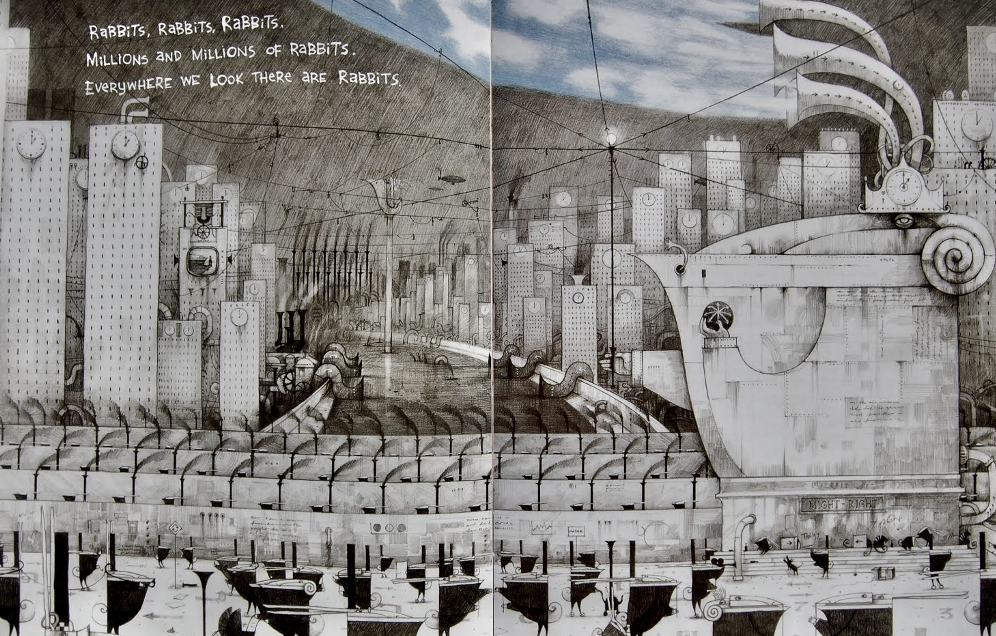
(Marsden, 1987, opening 11)
As Marsden writes, “Rabbits, Rabbits, Rabbits. Millions and millions of rabbits. Everywhere we look there are rabbits.” (Marsden, opening 11) Rabbits spread across almost all of Australia within fifty years of their release, they have colonised Australia’s natural world, having drastic and irreversible effects on the native habitats. It also represents the oppression of Aboriginal people by the British colonialists. As Gross says, “The world before the rabbits was tranquil, plentiful and not ordered by the governing principles of production and industrialisation” (Gross, p.118) in reference to the British colonisers. ‘The Rabbits’ (1998) captures the real history of colonisation within its pages, specifically paralleled with British colonialism in Australia, but also parallel to the invasion of Australia’s ‘Public Enemy No.1’, the rabbit, and most likely inspired by Australia’s national opinions upon the creature. This is an example of how the rabbit has been used in art to represent social and historical events throughout Australian history.
Effect on Aboriginal Art
In response to the rabbit invasion, as mentioned earlier, came the Rabbit Proof Fence. The fence was erected by those who ‘owned’ the land, and no one native to Australia had a part (or choice) in building it. The fence, over time, has become important to those of Aboriginal descent, representing the physical and metaphorical barriers that they have experienced under colonization. It is also representative of the ‘Stolen Generations’, the forced separation and containment of Australian Aboriginal and Torres Strait Islander children and their ‘Assimilation’ into white culture.
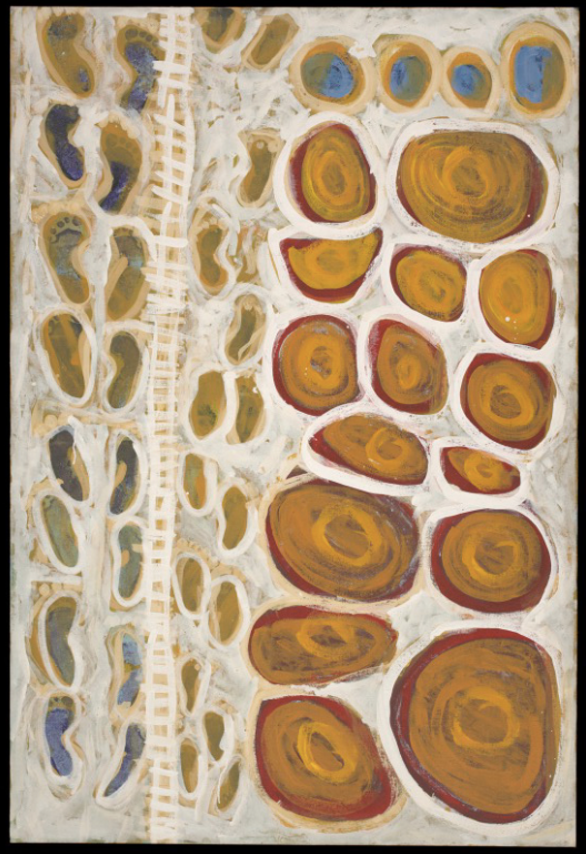
‘Footprints on the Rabbit Proof Fence’ (1987)
Focusing on Judith Samson, or Anya, a Martu Australian artist from Aboriginal decent who paints important aspects of the Australian landscape, such as ‘Footprints on the Rabbit Proof Fence’ (1987). Samson’s work takes major influence from her Dadda’s (Grandmother) teachings of Walka, the iconographic forms representing people, animals, land formation, etc., whilst incorporating her own language and expression, paints her surroundings: Puntawarrri, Jigalong, and the Rabbit Proof Fence. This is not uncommon within Martu paintings, as Samantha Higgs, a specialist in Australian Aboriginal heritage, mentions, “the Martu idea of Country and their relationship with Country is expressed in their art” (Higgs, p.1), which in this case, is the Martu’s relationship with the Rabbit Proof Fence. Samson says her painting pertains to “the girl and the baby walking along the Rabbit Proof Fence” (Samson, 1987), possibly a reference to the story of three Aboriginal girls that were removed from their homes as part of the ‘Stolen Generation’, who then escaped, using the Rabbit Proof Fence, following it across country back home. This story and the fence hold ideas of resilience for the Aboriginal communities “This country is Puntawarri, that’s our county” (Samson, 1987). However, in the painting, the fence cuts off the two sets of footprints from one another. This could be interpreted as symbolizing what the fence separated the Martu’s from. As mentioned by the National Museum of Australia, “Here the artist has painted the fence, and shown how that line cut across the traditional country, water and walking paths of her ancestors.” (nma.gov.au, 2025, para. 3). The footprints alone on the left side of the fence being Samson or her people, and the footprints on the other side resembling her ancestors and the journeys, lands, and water holes lost to the other side of the uncrossable fence. This painting depicts the varying impacts that the Rabbit Proof Fence has had on Aboriginal communities, and the cultural significance that the fence continues to have within Aboriginal art.
Conclusion
It has been particularly insightful delving into the rabbits of Australia due to its deeply negative history. Especially when to me personally, like with Pollak, the rabbit is a friend. This research has challenged me to look beyond the appealing features of rabbits, and instead to contemplate the historical and artistic context they may hold.
Within ‘The Rabbits’ (1998), Tan’s paintings tell a majority of the story and Marsden’s use of rabbits are unequivocally important. Together they have made the rabbit vital to the story being told. To utilize the imagery and societal opinion of the rabbit in this way is hugely inspirational to my practice. As a multidisciplinary artist, my medium is only ever relevant to what I am currently portraying. Meaning that my interest in the subject of the Rabbit, transcends sculpture, into the symbolism of rabbits in any form. Sometimes illustration. It spurs me on to consider how my rabbits may tell a story, or accompany a story, like that of ‘The tale of Peter Rabbit’ (1902) by Beatrix Potter or ‘The Runaway Bunny’ (1942) by Margarete Brown yet still fit within the context of contemporary fine arts, not just considered a children’s book.
In a looser sense, Samson’s ‘Footprints on the Rabbit Proof Fence’ (1987) uses the historical context and impact of the rabbit to depict stories that hold cultural significance, without using rabbit imagery. This shows me it is important to also consider my muse in an abstract way, not just confined to literal figures.
The introduction of the European rabbit (Oryctolagus cuniculus) to Australia through British Imperialism has had a lasting, significantly devasting effect on its native habitats and fauna, completely transforming Australia’s environment. Which in turn, has had a lasting effect upon its society and art. With ‘New World Order – Terra Australis’ (2011) we see the effect the invasion has had on the Australian people, who battle conflicted opinions due to relationships with their domesticated pets. With ‘The Rabbits’ (1998) we have an allegory of colonialism that uses the destructive and invasive creatures to tell its story. And finally, shown through art within the Martu communities such as ‘Footsteps on the Rabbit Proof Fence’ (1987), we see the disruptive impact that the attempts to counter the rabbit onslaught has had. These tales have left me with much to consider within my own practice and I am personally excited to see where this research might take me.
Bibliography
Barr, D. (2024) Before Orion [image], unpublished work
Menace of The Rabbit (1948) [Film]. Director Unknown. Australia (4:06 mins)
Available at: https://www.youtube.com/watch?v=UMbDmKX3rnk
[Accessed: 29th January 2025]
Samson, J.A. (1987) Footprints on the Rabbit Proof Fence [online]
[Accessed: 29th January 2025]
National Museum of Australia (1859) Stevenson’s Wire fence [online]
Available at: https://digital-classroom.nma.gov.au/images/cartoon-titled-stevensons-wire-fence-queensland-figaro-1884
[Accessed: 29th January 2025]
Tan, S. (1997) Meeting [online]
Available at: https://www.shauntan.net/rabbits-book
[Accessed: 29th January 2025]
Tan, S. (1997) They came by water [online]
Available at: https://www.shauntan.net/rabbits-book
[Accessed: 29th January 2025]
Tan, S. (1997) Rabbit Houses [online]
Available at: https://www.shauntan.net/rabbits-book
[Accessed: 29th January 2025]
Tan, S. (1997) They ate our grass [online]
Available at: https://www.shauntan.net/rabbits-book
[Accessed: 29th January 2025]
Marsden, J. (1998) The Rabbits. Australia: Hachette Australia. (my photo)
Pollak, J. (2011) New World Order – Terra Australis [online]
Available at: https://www.nma.gov.au/explore/features/rabbits-in-australia/jenny-pollak-sculpture
[Accessed: 29th January 2025]
National Film and Sound Archive of Australia (n.d.) MENACE OF THE RABBIT [online]
Available at: https://www.collection.nfsa.gov.au/title/72463
[Accessed: 29th January 2025]
Crisp, R. (2009) Run Rabbit, Run Rabbit, Run, Run, Run. AQ: Australian Quarterly [online], v.81 (5), pp. 36-37
[Accessed: 29th January 2025]
The Lancet (1909) RABBITS AND SHEEP IN AUSTRALIA. Journal of the Royal Society of Arts [online], v.57 (2963), pp. 864-865
Available at: https://www.jstor.org/stable/41338799?searchText=rabbit+art+australia&seq=2
[Accessed: 29th January 2025]
Man, G. (2015) Rabbit-proofing the West. The People & Environment Blog [blog], 21st September 2015
Available at: https://pateblog.nma.gov.au/2015/09/21/rabbit-proofing-the-west/
[Accessed: 29th January 2025]
National Museum of Australia (n.d.) Rabbits in Australia [online]
Available at: https://www.nma.gov.au/explore/features/rabbits-in-australia
[Accessed: 29th January 2025]
National Museum of Australia (n.d.) Rabbits introduced [online]
Available at: https://www.nma.gov.au/defining-moments/resources/rabbits-introduced
[Accessed: 29th January 2025]
Western Perspectives on a Nation (n.d.) The Rabbit Proof Fence [online]
Available at: https://webarchive.slwa.wa.gov.au/wepon/land/html/rabbits.html
[Accessed: 29th January 2025]
State Library of Western Australia (n.d.) The Rabbit-Proof Fence [online]
Available at: https://slwa.wa.gov.au/stories/wa-history/rabbit-proof-fence
[Accessed: 29th January 2025]
Ryan-Fazilleau, S. (2006) RE-VISIONS OF TWO ABORIGINAL HISTORIES: “RABBIT-PROOF FENCE” AND “AUSTRALIAN RULES”. Hungarian Journal of English and American Studies (HJEAS) [online], v12 (1/2), pp.105-114
[Accessed: 29th January 2025]
Martin, J.H. (2003) RABBIT PROOF FENCE. New Blackfriars [online], v.84 (993), pp. 531-534
[Accessed: 29th January 2025]
Higgs, S. (2016) Martu paint country. The archaeology of colour and aesthetics in Western Desert rock art and contemporary acrylic art [online], Ph.D. thesis, The Australian National University.
Available at: https://www.proquest.com/docview/1994456362/1E9FAE129288493DPQ/1?accountid=12118&sourcetype=Dissertations%20&%20Theses
[Accessed: 29th January 2025]
Martumili (n.d.) About Us [online]
Available at: https://martumili.com.au
[Accessed: 29th January 2025]
cbOne Gallery (n.d.) JUDITH ANYA SAMSON [online]
Available at: https://www.cb-onegallery.com/artists/judith-anya-samson
[Accessed: 29th January 2025]
National Museum of Australia (n.d.) Creating the Canning [online]
Available at: https://www.nma.gov.au/exhibitions/kaninjaku-canning-stock-route/stories/creating-canning
[Accessed: 29th January 2025]
Bird, D.W., Bird, R.B., Codding, B.F., and Taylor, N. (2016) A Landscape Architecture of Fire: Cultural Emergence and Ecological Pyrodiversity in Australia’s Western Desert. Current Anthropology [online], v.57 (S13), pp.S65-S79
[Accessed: 29th January 2025]
Do Rozario, R.-A.C. (2011) Australia’s Fairy Tales Illustrated in Print Instances of Indigeneity, Colonization, and Suburbanization. Marvels & tales [online], v.25 (1), pp.13-32
[Accessed: 29th January 2025]
McGlasson, D. (2013) A Toothy Tale: Themes of Abjection in John Marsden and Shaun Tan’s Picture Story Book, The Rabbits. The Lion and the Unicorn [online], v.37 (1), p.20-36
[Accessed: 29th January 2025]
Shaun Tan (n.d.) The Rabbits [online]
Available at: https://www.shauntan.net/rabbits-book
[Accessed: 29th January 2025]
Gross, J. (2021) New worlds: violent intersections in graphic novels. In: Masschelein, A., Mussgnug, F., Rushworth, J. (eds.) Mediating Vulnerability: Comparative approaches and questions of genre [online], UCL Press pp.116-132
[Accessed: 29th January 2025]
National Museum of Australia (n.d.) Exploring the relationship between humans and rabbits [online]
Available at: https://www.nma.gov.au/explore/features/rabbits-in-australia/jenny-pollak-sculpture
[Accessed: 29th January 2025]
